
 Gianluca Minoprio
Building a bank used to start with a license. Now startups launch with a few lines of code. These startups mark the beginning of what I call next-gen banks. They are built on stablecoins with a hybrid-custody model that allows users to open accounts in seconds. They ship in months at a fraction of the cost, and scale across borders from a single backend.
Last year I ditched my traditional bank accounts. I now live on a next-gen bank called Fluidkey. You open an account in seconds with an email or your own key if you’re crypto-savvy. It’s sovereign by default and has privacy features. If you choose to do KYC afterwards, they unlock virtual U.S. and E.U. accounts that auto-convert deposits into digital dollars earning around 6%. My U.S. salary lands there, I earn interest automatically and can invest in gold through XAUT. A three-person team in Switzerland built this in a few months. On top of that, if they wanted to support a new country, it would be an API configuration away, no multi-year licensing grind and no backend rebuild. That’s the power of a next-gen bank.
I’ll start by highlighting the current market of next-gen banks, then define what a next-gen bank is and how they’re built, and finish with where all of this leads, vertical, identity-based banks that could become the last bank you’ll ever need.
What we are seeing
Across countries with unstable currencies, people seek the U.S. dollar. That’s why the first wave of stablecoin banks took off. DolarApp serves over a million freelancers across LATAM. Lemon exploded in Argentina, offers ~6% APY on dollar savings via Morpho, beating the saving accounts at traditional U.S. banks. MiniPay expanded in Kenya and Nigeria and now has 9M+ accounts, letting users hold digital dollars and spend like a local.
Stablecoins are the fastest way to hold and move dollars without needing a U.S. bank account. For founders, they’re also the easiest, cheapest foundation to launch a consumer fintech app. Through stablecoins they offer global transfers, access to modern financial products, and connectivity to local fiat rails without heavy licensing.
Across Latin America, Africa, and parts of Asia, stablecoins have quietly become the new savings account. They’re dollar denominated, accessible from any phone, and transferable instantly. In Argentina, inflation topped 200% in 2023. In Venezuela and Nigeria, currencies can halve in a year and bank accounts face tight currency controls and withdrawal limits. In Bolivia, digital currency usage reportedly jumped ~500% after the devaluation of the national currency.
The pattern is simple: the higher the inflation, the stronger the dollar saving behavior is.
To illustrate this, in 2023 when inflation peaked in Argentina, interest in stablecoins surged almost in sync. Even after the Consumer Price Index cooled under Milei’s government, search volumes for “USDT” stayed high, showing that once people learned to protect their savings with digital dollars, the habit stuck. What began as a reaction to the crisis became a new financial behavior.

Under the hood, stablecoins give builders what legacy rails can’t: a single global backend. Instead of wiring through country-specific systems, every transfer, saving, and reward runs on the same programmable ledger. It’s instant, verifiable, and comes with a plug & play financial services, the perfect foundation for small teams to launch what used to take entire banks.
But not all stablecoin banks are built the same. There are two main architectures that define the playbooks they can run: one makes them an incremental upgrade to neobanks, while the other brings them closer to being true next-gen banks.
How They’re Built
A stablecoin bank looks like a traditional one on the surface: you open an account, you can send and receive on fiat rails and get a card to spend. But underneath, it runs on a blockchain. The difference is structural: the blockchain replaces dozens of national banking systems with one programmable core.
Today we see two main approaches.
Custodial
Apps like DolarApp, Lemon, or Takenos feel familiar. You sign up, pass KYC, and your funds are held by the company. Recovery is easy and customer support can reset your credentials. Each new country requires new licenses and local entities. Based on a conversation with one neobank founder, about 70% of users drop off during KYC. Custodial apps lack instant onboarding. They feel like traditional neobanks with faster plumbing.
Self-custodial
Apps like Kontigo, Payy or MiniPay take the opposite route. You open an account in seconds, no KYC form to fill, because the app never holds your funds. A big advantage of self-custody is that it lets the company be available across countries with no licenses, just the right compliant local on/off ramp partner. Companies can design more aggressive funnels, onboarding users through something as simple as receiving money via a message link. But self-custody comes with trade-offs: people lose access, get scammed, or fear keeping life savings on their phone. Recovery still matters and most users will never manage it. Real world security risks, like recent kidnappings in France targeting crypto holders, highlight why few want full sovereignty over large amounts.
The solution sits in a hybrid model:
- Self-custodial core: for instant onboarding, global interoperability, no single point of failure.
- KYC features: add guardians, spending limits, and local fiat features like cards or bank account numbers.
Custody becomes a dial, not a binary. You start open and sovereign, then add a layer of security, compliance and convenience over time that can be done through partnerships plugged on top and not directly by you. The self-custodial core is critical because it lets you add compliance when and where it is required, rather than being constrained by it.
This hybrid design especially helps to scale across countries. Instead of relicensing every market, you keep one backend and plug in local ramps, a model increasingly abstracted by single-API providers like Borderless. Expansion becomes configuration, not bureaucracy.
Next-gen banks fuse self-custodial wallets with custodial stablecoin neobanks. This architecture unlocks the unfair advantages: speed, composability, and instant funnel that legacy players can’t match.

The power of Next-gen Bank
Why does a tiny team feel giant? Because next-gen banks win on three axes: time & cost to market, plug & play finance, and open now, KYC later.
Time & cost to market
Small teams can now ship full banks on a startup budget because the components are available off the shelf: wallet infrastructure, fiat ramps, card issuing, and even programs to issue your own dollar stablecoin to get revenue. As these primitives mature from crypto into banking UX, the experience will surpass legacy neobanks. Scaling in new countries no longer means relicensing, but reconfiguring: switch ramps, issuers, or local units of account on the same backend. The burn looks like a SaaS bill, not a bank capex plan.
[Next-gen banks will direct their funding towards distribution instead, beating incumbents on marketing and rewards.]
Plug & play finance
Blockchains are open financial backends. Teams can plug into proven products from day one. Take Aave, live for over eight years with more than $75 billion in supplied assets. A next-gen bank can route customer funds into AAVE to generate safe interest and pull funds back instantly when users spend. Add direct FX, tokenized gold (XAUT), or stock exposure (xStocks). You get an open menu of products, from conservative to higher-volatility, all maintained externally. Users enjoy 24/7 pricing, no weekend spreads, and a direct connection to the market.
All stablecoin apps can access this plug & play finance ecosystem. But one thing that custodial stablecoin neobanks can’t replicate compared to a next-gen bank is the instant onboarding funnel.
Open now, KYC later
Traditional fintech starts with friction: 15 minute forms, selfie checks, and review queues. Next-gen banks flip that flow. You open an account in seconds, receive money from a friend, and start earning immediately. When you’re ready to get a card, higher limits or virtual bank accounts, you complete KYC later.
Apps like MiniPay show the pattern:
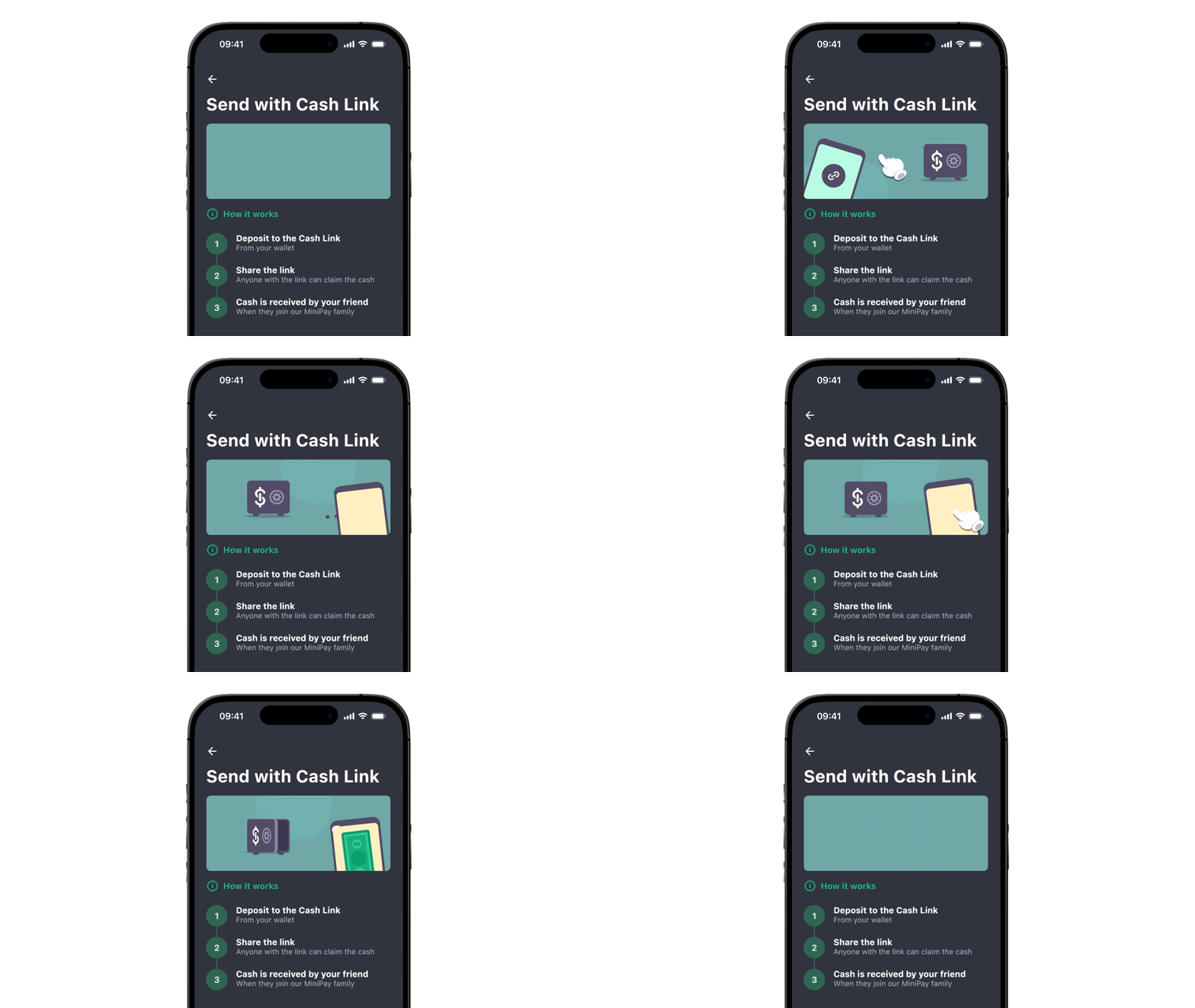
send money to a phone number → if the user isn’t onboarded, they receive a WhatsApp link → tap → onboard in seconds → funds instantly available.
The onboarding no longer starts with a KYC, it starts with value.
Risk & Challenges
Not everything about open finance is simple or safe. Open finance relies on smart contracts that can fail, interest on dollar savings fluctuates with market demand, and stablecoin issuers vary in reliability. The same composability that powers next-gen banks also introduces fragmentation: dozens of networks, stablecoins, and liquidity sources. This creates friction for both users and builders. Custodial models can handle this complexity behind the scenes, but they lose the advantages mentioned above. Next-gen banks, on the other hand, must make users move funds themselves.
That’s the problem we’re solving at Daimo.
We believe fragmentation will keep growing, and simplicity will win. Daimo is a non-custodial clearing house that lets users without KYC move any major currencies across networks and automatically route it to the target currency and network the next-gen bank want. In short, it hides fragmentation, connect next-gen back together so builders can focus on their products.
For example, Daimo already connects World and MiniPay in a single click, letting users send money 1:1 from USDT on Celo to USDC on Worldchain. Or Kontigo, which supports USDC on Base, can now accept USDT on Tron, the most popular rail in LATAM.
Daimo makes it feel like one seamless network like sending from one bank to another.

Now that it’s possible to launch a compliant, cross-border bank in months, the frontier shifts. You don’t win on fees or feature checklists, you win on something else. The question becomes: who is the bank for, what does it stand for, and how does it fit into people’s lives? In a world of plug & play open finance, fees and financial services are a race to the bottom. These banks will have to win on meaning. You won’t just use a bank, you’ll join one, the way you join a community. That’s the moment I call the endgame: the last bank you’ll ever need.
The End Game
Traditional banks scale by region, next-gen banks scale by community.
Revolut was built for the U.K., then expanded country by country. But Kontigo isn’t a bank “for Venezuela”, it’s for Venezuelans, a distributed community spread in the United States, Spain, Colombia, and Venezuela, all sharing one financial core. This difference changes everything. Instead of serving users inside a border, next-gen banks serve people across borders who share a language, a culture, a purpose.
This is the playbook shift. DolarApp is doing it with freelancers across LATAM. MiniPay with Africans. Kontigo with Venezuelans.
There are so many opportunities for next-gen banks:
- The Ukrainian bank helping families split between Kyiv, Warsaw, and New York share money, pay rent, and crowdfund reconstruction.
- The Argentine savings club, letting millions abroad in Spain or Miami hold and send pesos or dollars seamlessly.
- The Filipino bank serving the millions of Filipinos abroad who remit $36 billion each year to their families.
And if we take it further, these verticals won’t just be tied to nationality. The next layer will be interest driven banks, for creators, gamers, brands, or even fandoms. The rails are open, the backend is ready, the missing piece is creative founders who know how to unite a community under one financial identity.
This is the path to the last bank you’ll ever need, a new generation of banks that scale vertically across borders, anchored not in geography, but in identity.
One story that obsesses me lately is Erewhon, the high-end Los Angeles grocer that’s become a status symbol. Their $20 celebrity smoothies (like the Hailey Bieber drink) turn each launch into an event. What’s fascinating isn’t the smoothie, but the business model behind it: when Erewhon creates a new drink, ingredient brands get in a bidding war to be included, because they know this audience cares about labels and will buy those products. Celebrities get a revenue share on every sale, placement on Erewhon’s shelves to a perfectly targeted audience, and the store cements itself as a cultural hub.

Now imagine applying that model to banking. We’re already seeing early versions of it.
Coinbase launched an Amex card that offers 4% back in Bitcoin. You can fund it straight from USDC (digital dollar) balances earning ~4% APY or from a linked bank account. The branding is subtle: not a giant ₿, but the Bitcoin genesis block engraved on the card. To most people it reads as a premium card and to nerds it’s a conversation starter. This is a vertical play: built for a high-intent crypto niche, not for everyone. If they took it cross-border, they’d likely lean on Base, their globally available self-custodial stack and tune rewards, still targeting a tight community.

Push further and you get the pattern: rewards and financial features built around a specific community whose behaviors rhyme across countries. A Pokémon fan in the US and one in Europe probably want the same things. Closer to reality, Kontigo builds for Venezuelans across countries. Instead of generic airline miles, you can offer culturally resonant perks. Do this well and you assemble an experience legacy generic neobanks can’t match because they don’t serve a niche community.
Despite all the controversy surrounding him, Kanye West is once again ahead of the trend. He has already hinted at this model with $YZY, his own digital currency teasing a Yeezy “bank”. If that model matures, a YZY Bank would serve a community with shared tastes, letting you tune rewards to that community far better than any generic bank could.

At Daimo we’ve long joked about a “Bank of Mr Beast” as the ultimate expression of this model. MrBeast is a distribution monster, master of brand extensions, and a brand built around winning money with global reach. As I was polishing this essay, rumors surfaced that it might become real. Jimmy, if you need any advice I’m here!
That’s the logical conclusion of the next-gen model: when the backend becomes accessible, the real moat becomes culture. Banking becomes a canvas for identity and founders shift from financial engineers to cultural architects.
And that, to me, is the endgame. When you stop choosing a bank for its logo and start joining one because it represents who you are, that’s when we’ll have reached the last bank you’ll ever need.
Conclusion
I’ve never been more convinced that we’re entering the WhatsApp moment for money where simplicity, openness, and speed finally converge.
The tools are here: stablecoins, wallet infrastructure, and compliant ramps that make global banking possible for anyone with an internet connection. What’s missing is not technology, it’s imagination.
The first generation of fintech founders digitized banks. The next will redefine what a bank means. They’ll build the first banks people actually want to belong to.
The infrastructure is getting more mature every day. We have audited issuers, safer custody solutions, and real rulebooks through real proposals like the GENIUS act in the US. The opportunity is wide open.
All we need now is the new generation of builders, the ones who will give people not just a better bank, but the last bank they’ll ever need.
If this resonated with you or you disagree, I’d love to hear your thoughts: gianluca@daimo.com
Thanks to Andrew Liu, DC Posch, Cush, Gray Newfield, Hugo Montenegro, Georgios Konstantopoulos and Thomas Bubert for feedback and edits.
